



Aiming to Mob Graze 365 Days A Year
Through long rest grazing, pond creation, scrub encroachment and wildlife focused practices, Mill Barton Farm is bringing back wildflowers, birds, and resilience to the Culm.
BIODIVERSITY CASE STUDY
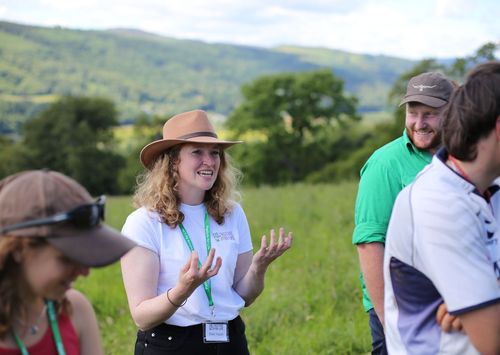
Bella Lowes and Mill Barton Farm, Mid Devon
Tell us about your farm - its location, size, altitude, climate, soils, enterprises; organic, Pasture For Life or another status?
Mill Barton is a small farm of approximately 100acres in mid Devon. Not all the land is contiguous: every part of it is going through a different phase of reversion from either intensive high input mono crop grassland, or high input fodder cropping. Like many farms in this area, we are lucky enough to have deep, generally unspoilt valleys (or goyles), home to closed canopy oak woods, alder and willow scrub, water courses of all shapes and sizes with the associated flora. The land rises from approximately 550 to 700 ft above sea level, which has its own challenges but it is also a huge advantage, above all, offering shelter. We farm to Pasture For Life and organic principles but are not formally accredited with either.
We are in the Culm Measures, meaning there is a seam of clay very close to the surface. Twinned with high rainfall, this area can retain both its water and its nutrients extremely effectively. The soil is generally marginally acidic with areas which are more loamy and some areas on seams of sandstone shillet. Being so far west and under the influence of the Atlantic, temperatures remain fairly mild here with high rainfall and no more than a couple of weeks of frosts in late winter. In the summer, we very rarely see temperatures over 30 degrees.

Give us a general description of the biodiversity on your farm - essentially above ground but reference to below ground, both flora and fauna
Since moving here in 2003, thousands of native trees have been planted to extend and connect established hedges, copses and woodland. Nearly all of this has succeeded to become healthy semi-mature woodland which we run our cattle through twice a year. There are nearly 6kms of hedgerows, some of which are newly planted and all of which are in a 10 - 20 year cut and lay rotation. Tall, thick, species-rich hedges are such a powerful tool to help mitigate the biodiversity crisis.
This spring for example, when we were subjected to cold temperatures and strong easterly winds, the hedges provided us with essential shelter for our livestock, foraging and nesting habitat to invertebrates and birds, and they were a corridor for mammals.
They retained water in the landscape and broke the wind. When the orange tip butterflies should have been out in the meadows foraging on the cuckoo flower, they were only able to fly in the leigh of the hedges. Moving forward we are keen to encourage the encroachment of the hedges into the fields, creating more scrub, and instead of using them as boundaries, we will focus more on using electric fencing to dictate the areas that are grazed and browsed or excluded.
In the past couple of years we have dug multiple ponds and shallow scrapes, not only to provide water for our livestock where there are no permanent toughs but also to encourage more aquatic life - certainly dragon flies are an essential predator during fly season. The invertebrate hatches also provide food for swallows, house martins and swifts and in turn, they predate the flies which can become a nuisance to our livestock.
Having an option when it comes to water provision for the cattle means their impact doesn’t become an issue to the land - e.g. compaction or poaching. The ponds on the farm also catch a lot of the nutrient leaching before it gets into the watercourse - at the moment, the most recently dug ponds suffer from eutrophication fairly quickly demonstrating the unnaturally high phosphate in the soil.
Due to historic land management practices here, the clay is severely compacted in places and has suffered from significant topsoil depletion. However, it is recovering: we see not only in soil analyses but also with changes in the diversity of the sward - increasing pioneers, the amount of water we are able to store in the landscape, the flocculation of the soil and with all the animals who have come to take advantage.
In areas which are a few years into their restorative process, we see classic meadow species such as birdsfoot trefoil, lesser trefoil, ox-eye daisies, yellow rattle and red clover, as well as more Culm-specialty species such as common valerian, angelica, hemlock water dropwort, ragged robin and devil’s bit scabious. There is a lot of willow (goat and white), alder and hazel as well as more established oak and beech.
"The bird life at Mill Barton is spectacular - we are regularly able to watch goshawks hunting, as well as the occasional passing hobby, peregrine and red kite. The warbler numbers, particularly garden warblers and blackcaps, are increasing in lockstep with increasing scrub cover in the goyles. We regularly see roe deer and foxes and more sporadically red deer and hares."
What you do to encourage this biodiversity and the lessons you have learned/would like to share?
All through the spring and summer, the cattle are mob-grazed around the farm: we use single strand polywire to place them where we need them. We don’t write a grazing plan because we have learnt that we stray from this almost straight away!
We do aim to leave land for at least 50 days between repeat grazings. Instead of writing a plan, we respond to what we see in front of us: early in the year we need to keep them away from some of the wetter flushes, and later in the year we want to get the sward down really tight to allow us to hand-seed the ground behind them. We follow the cattle with horses - they cross graze extremely effectively and as a result, our parasitic worm burden is practically zero. We never worm any of our animals unless there is a clear issue, at which point we assess before administration. The horses also help in creating areas with an extremely short sward - suitable for oversowing and allowing seed fall - as well as leaving areas such as their latrines, which get much rougher. This is essential winter habitat and a good spring cache for the cattle.


High input grassland has pervaded the south west resulting in the near elimination of species-rich swards. Pioneering “weeds” such as docks have proliferated as a result. At Mill Barton we see their role as essential. With very few deep rooting perennials in the sward early in the process, these “weeds” are important nutrient cyclers, essential nutrient-filled forage in the early season and they provide food for birds, caterpillars and other invertebrates.
Over the past couple of springs, which have yielded very little grass growth, the cattle are provided with healthy, tannin rich fodder by leaving the docks, and, even when moved into new paddocks, they will not leave them. Fields that are further down the restoration road and have a far higher variety of species in the sward have generally squeezed these weeds out. White clover is another indicator of the compaction at Mill Barton and as a result it is a goal that we see its dominance decrease, however, for the time being it is another essential food plant both for the livestock and the bees and butterflies.
We leave as much standing forage over winter and through the summer as possible. Not only is this important fodder for the cattle that remain outside, but it also provides incredible habitat for invertebrates and over-wintering birds such as snipe and woodcock, which we see and hear from the early evening into the night eating from the dung of the out-wintered cattle.
The seed heads from the standing hay are invaluable to small birds - we have seen an explosion in the numbers of linnets and goldfinches over the past couple of years, as well as large increases in bull and greenfinches, gold crests and pied wagtails. The long grass has provided acres more habitat for voles, shrews and mice which has lead to increasing numbers of tawny owls and a stable family of barn owls.
"There is a symbiosis between the birds and the cattle."
Before the swallows arrive in spring, the mob is followed around the farm by wagtails and robins, as well as various corvids who sift through the dung before the soil warms up enough to allow the worms to get active. When the swallows do arrive they forage everyday, without fail, around the cattle.

In late autumn, when the herd is still outside, we occasionally unroll species-rich hay bales from one of the restored meadows on the farm for them to eat. This method has definitely helped a few species encroach into the fields with very low species diversity. As our own meadows improve, we will do this more and more frequently in the autumn and in the spring, before the grass growth really gets going. We have learnt that one of the best methods of increasing species diversity is long rest periods after hard-grazing (which allows seed fall or provides areas we can seed ourselves).
"Before the swallows arrive in spring, the mob is followed around the farm by wagtails and robins, as well as various corvids who sift through the dung before the soil warms up enough to allow the worms to get active. When the swallows do arrive they forage everyday, without fail, around the cattle."
[REMOVE LINK]What are the benefits to the farm?
The benefits to the farm are numerous. In areas which were historically overgrazed (but not ploughed) the increase in floral diversity is enormous, in only a couple of years. By grazing with extensive rest periods and at specific times of the year, indicative Culm or wet pasture perennials have appeared in some places and spread out from others, where they may previously have only numbered one or two plants.
As the floral diversity has increased the number of pollinators, birds and mammals beyond them have also increased. Whenever we look up, there are birds of all types flitting around. Whenever we look down, there is always something moving under our feet.
"All this diversity is building resilience into an increasingly stretched system."
How do you monitor it?
Moving the cattle everyday, even the ones left out over winter, means that we circumnavigate the farm twice a day, every day. This allows us to feel the changing seasons and see the micro alterations through the year. Each time we enter an area previously grazed, we look for changes and try to identify patterns - year on year we become more intuitive. Given our upbringing, immersed in the countryside, a lot of that knowledge has grown with us but when we started keeping cattle, it led us to search for more and to recognise the intrinsic connections between the grazers and what they are grazing. It is this symbiosis between our animals and the land, both of whom have evolved in lockstep, which is helping to increase biodiversity on our farm.
Our longterm goal is to increase our herd size in accordance with what the land can support and to keep them in the landscape 365 days a year. To achieve this, we recognise that diversity, in all things, is resilience, and that abundance is a reliable indicator of the health of the ecosystem as a whole.
We recognise the role of large herbivores in the landscape year round as essential: their grazing and browsing habits as well as their herd behaviour, and so we see the beef we produce as a byproduct of the essential work that our cattle are doing to restore the land they roam.
"In areas which were historically overgrazed (but not ploughed) the increase in floral diversity is enormous, in only a couple of years."
[REMOVE LINK]