


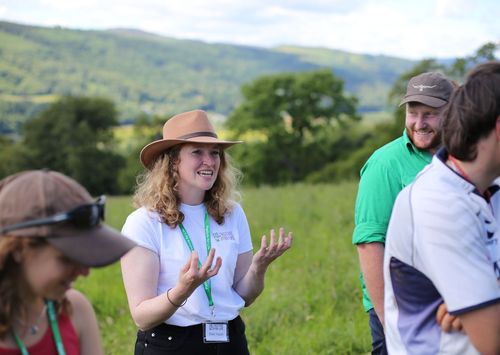

Intensive Arable To Wildlife Haven
Ian Boyd’s Cotswold farm went from high input arable to a thriving mosaic of wildflower meadows, herbal leys, woodlands and wetlands.
BIODIVERSITY CASE STUDY
Ian Boyd and Cotswold Beef
About your farm
Whittington Lodge Farm is a Cotswold Hill farm which is managed with the neighbouring Whittington Estate totalling 280 ha. It is Organic, Pasture-for-Life and Red Tractor certified. There are steep valleys and hilltops to 900 feet, a Site of Special Scientific Interest (SSSI) and a Scheduled Monument in the Roman town of Wycomb.
65 ha of Wildflower meadows were created from thin brashy arable land 15 years ago and they have now been assessed as species-rich Calcareous grassland on the Priority Habitat Inventory.
There are 30 ha of steep and heavy Permanent Pasture and 70 ha of rotated Herbal Leys as well as 50 ha of Spring Barley with over-wintered stubbles. There are also 10 ha of floristically enhanced margins, 10 ha of Wild Bird Seed Crops, 5 ha orchard and 30 ha of scrub and woodland.
The grassland is managed by a herd of 50 Pedigree Hereford cows, calves and their fattening youngstock. All beef is sold direct to customers under the brand "Cotswold Beef".
All this is a long way from how it was farmed prior to 2005 when it was nearly all intensive arable with grain fed cattle. It has been quite a journey which required a mindset change to low input farming.
What made you think about your farm's biodiversity?
A love of wildlife photography and the succession of environmental stewardship schemes which enabled our farm to prioritise our farmland wildlife.
How did you get started on species identification?
I had inspirational teachers at both my schools who gave me a great interest in wildlife. I was a "Gosling" at Slimbridge Wetlands Centre and did a lot of school bird ID competitions. Peter Scott was the father of a school friend and he was inspirational too.
How many species of grass are in your pasture?
It is not so much the species of grass that I am looking for but legumes and herbs as they are essential to the fertility on an organic farm
Our farm has 3 types of grassland.
First there are 70 ha of herbal leys that are part of an arable rotation. We sow 5 species of grass, 5 legumes and 3 species of herbs. Their drought tolerance has been very noticeable these last couple of years.
Secondly there are 30 ha of permanent pasture on heavy uneven and steep land. Now that no inorganic fertilizers are applied, the number of species is increasing and less affected by drought.
Lastly 65 ha of former arable land with thin brashy soils has been reverted to wild flower meadows which after 15 years have now been assessed and included in the Priority Habitat Inventory as species-rich calcareous grassland. These are increasingly biodiverse with 43 species recorded on the best. They are not very productive but that was never the aim. They do however provide winter grazing.
How often do you test your soil and with what?
Not often or consistently enough. Several soil tests were done 4-5 years ago, from the simpler VESS and earthworm counts to expensive soil profiles. We found that the Loss on Ignition test also cooks the calcium carbonate in our limestone soils so unrealistically high SOM are recorded. But more importantly it enabled us to formulate a rotation and management to improve our soil heath within the constraints of Organic certification (no glyphosate, so No-till is not an option) and ensuring profitability - arable options are mostly more profitable than grassland options.
We really need to be monitoring our soils more regularly though we know that the 4-5 years of mob grazed herbal leys will improve the soils, but 2-3 years of arable will have a detrimental effect.
What we need to do is reduce the arable but it pays better and the farm has commitments to an inflexible Countryside Stewardship. The hope is that the much anticipated ELMS will incentivise farms to prioritise their soils.
Distinct habitats across the farm
Floristically enhanced grass margins. These are 6m wide and around every arable field. They offer insects a permanent refuge.
Wild Bird Seed Crops. Large flocks of goldfinches and linnets winter on our farm feeding on the mustard, quinoa, kale, fodder radish, chicory and cereal crops. These then attract merlin, red kites, sparrowhawks, hen harriers and short-eared owls.
Herbal leys. The herbal leys are a magnet for the roe and muntjac deer and numerous hares. In summer, the legume flowers, especially sainfoin, provide much needed food for pollinators all summer as well as improving the soil.
Organic spring barley and overwintered stubble. This is home to many species but especially the skylark. In the lee of the wind in the stubble, 50 skylarks can jump up in front of you. Their descending aerial song almost defines summer.
Orchard. The orchard is both for grazing and hay making as well as a crop of apples for juicing and food for several bee hives.
Woodland. There are 35 ha of scrub and woodland across the farm, half of it planted 20 years ago.
Ponds. 4 ponds were created across the farm, giving a home to a whole new selection of species on our previously dry Cotswold farm.
Headline species. Duke of Burgundy butterfly. Corn bunting. Barn owl, Little owl, Tawny owl, hares, Skylark, cuckoo. Occasionally seen: Hen harrier, Yellow wagtail. Short-eared owl. Quail. Grasshopper warblers, ring ouzels
What do you do to encourage this biodiversity?
To encourage this biodiversity has needed a mindset change away from intensive production-oriented farming. The whole farming system has to be a conversation with nature, considering at every stage how biodiversity can be helped. A mosaic of different habitats is important as it is the edge of habitats where much wildlife is found.
Creating the wildflower meadows from arable fields can be fraught process but all you really need is a topper and a lot of patience.
Very often a farm is judged by it's headline species. Whilst any rare and special species is great, the emphasis perhaps ought to be on the sheer mass of any biodiversity. A damp meadow heaving with insects is every bit as important as a rare species.
How is it connected across the farm and beyond?
There are a mosaic of different habitats across the farm with Floristically enhanced grass margins around every arable field. One larger field had a Beetle Bank created through the middle to break it up. A lot of tree planting was done 20 years ago (though sadly with much ash) and these areas are well connected.
All my neighbouring farms are conventionally managed. Increasingly there is greater acceptance of the way we farm. With the advent of ELMS, our farm is well placed to offer guidance and reassurance to others who may start off down this path.
And the benefits to the farm are...?
Our farm has benefited environmentally, economically and socially.
Environmentally our wildlife increased hugely since the monoculture arable days and it has given me a lot more to photograph.
Economically we have developed a brand "Cotswold Beef" to sell our produce with. It offers us great opportunities for upselling. We are currently developing tourism opportunities based on our wildlife.
Socially we meet a lot of people and share what we have to offer with them. Prior to the pandemic, we had 100's of visitors each year. We anticipate this increasing in the future.
How you monitor it?
My primary method of monitoring the farm's biodiversity is with my camera which is great for giving talks but it really does not satisfy the current requirements of evidence building and data.
In the past I have had numerous bird surveys done by our local bird survey group. They tend to do it as a hobby and their skill at identifying distant birdsong is critical. These surveys have been intermittent. Apart from personal interest there has been limited use of the data.
With the advent of ELMS, this data could and should be more important than ever.
"We have developed a brand “Cotswold Beef” to sell our produce with. It offers us great opportunities for upselling. We are currently developing tourism opportunities based on our wildlife."
[REMOVE LINK]Related resources

- Case study
- Sheep
- Blog
- Fibre
- Nature
- Cattle
- Herbal leys
- Planet
Sheep: Clive and Lydia Handy, Lower Hampen Farm, Andoversfor...
How Clive and Lydia Handy manage rare breed Devon Closewool sheep on a 100% pasture-fed system at Lower Hampen Farm, Gloucestershire.
12/08/25