


Restoring Ancient Meadows
How Olly Walker and family are turning 90 hectares of ancient Devon culm grassland into a nature filled farm, producing 100% pasture-fed beef and lamb, regenerating soils, restoring hedgerows, and linking people with farming and nature.
BIODIVERSITY CASE STUDY
Olly Walker, Essebeare Farm
Tell us about your farm, its location, size, altitude, climate, soils, enterprises, organic/PfL/other status
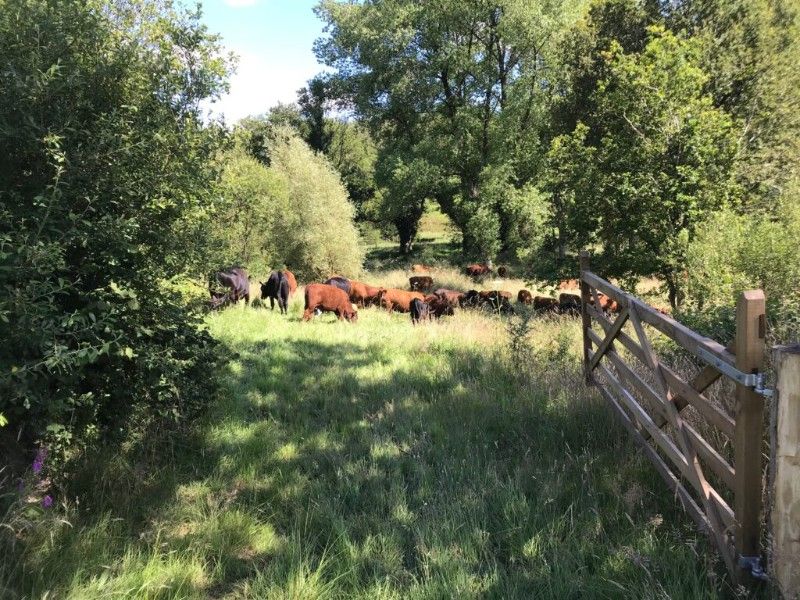
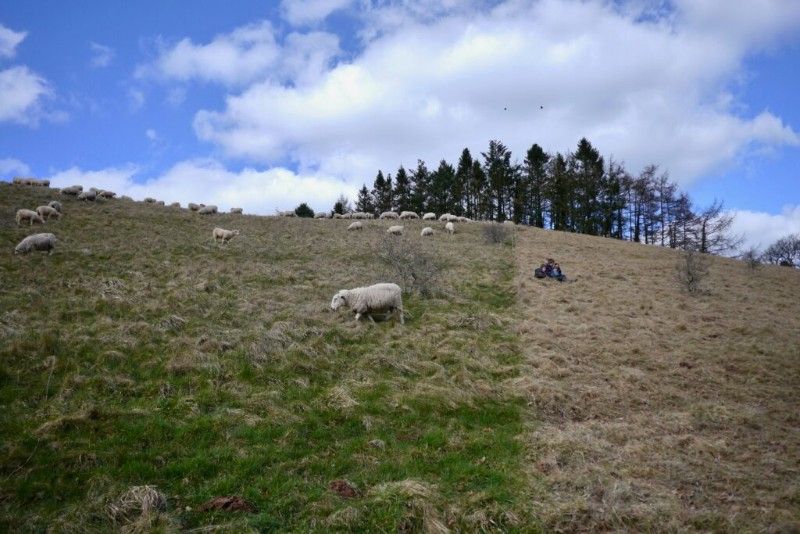
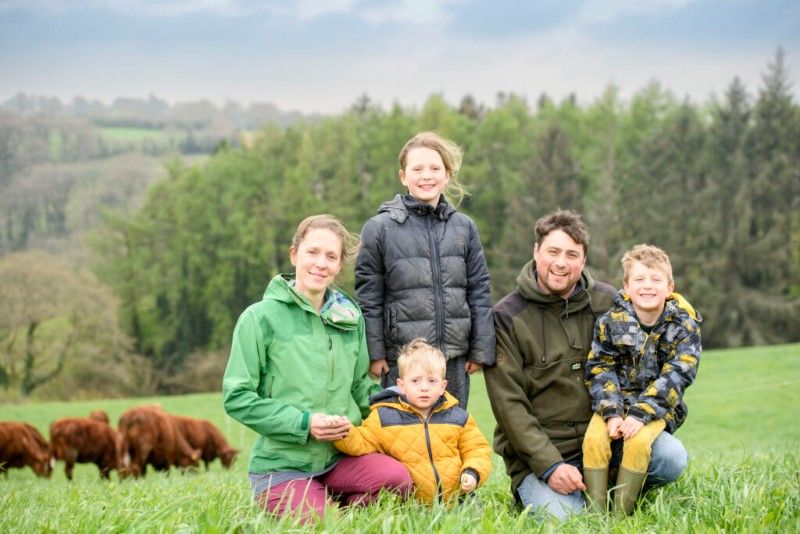
Essebeare Farm sits on ancient culm grassland meadows nestled in a hidden and beautiful Devon valley within the UNESCO North Devon Biosphere. Listed in the Doomsday Book as an ancient farm, it pre-dates enclosure. We farm a traditional suckler herd of 40 native Red Ruby Devonshire cattle and hardy Welsh Lleyn sheep on 90ha Pasture for Life Certified, Organic land, which focuses on rotational grazing, hedge and bank restoration and agroforestry.
We produce finished lamb and beef from diverse herbal leys and restored culm grassland meadows, as well as high quality, forage-raised breeding stock. Roughly half the farm has been managed under a higher-level stewardship (HLS CS) agreement.
Here at Essebeare Farm, we are passionate about managing and restoring the meadows and the hedge banks along the old, ancient lines - we aim to continue this restorative work with a new agri-environment scheme in 2022. We have recreated 2000m of lost earth banks and planted them with a diverse mix of trees and fruit-baring shrubs, specifically with birds and dormice in mind.
In 2015, we set up a rotational grazing platform, ringfencing our paddocks and subdividing with four strand 2.5mm high tensile fencing. We were literally one of Precision Grazing’s first customers. We imported Kiwitec electric fencing direct from New Zealand and began the journey of rotationally grazing a flock of 600 sheep. We have since reduced sheep numbers by one third. We are committed to genetic improvements within the flock and performance record twins.
Share with us a general description of the biodiversity on your farm – essentially above ground (but reference to below ground if relevant) – both flora and fauna.
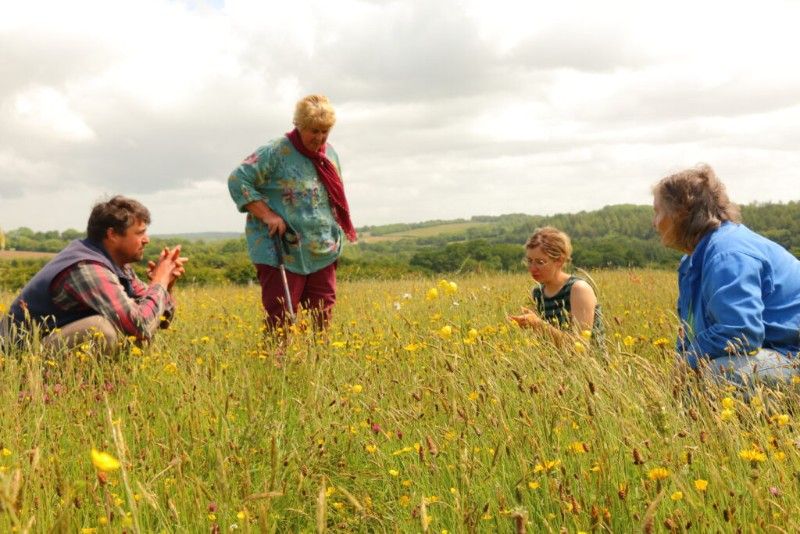
Within the holding, there are areas of semi-natural habitat, which have largely escaped the influence of agricultural intensification. A steeply sloping south-facing bank supports an abundance of wildflowers, knapweed and bird’s-foot trefoil and are interspersed with yarrow and cat’s ear. It is likely that only the steepness of the terrain has saved this area from ‘improvement’. This fragment of lowland meadow contains species that would have been prevalent just 100 years ago in hay meadows and pastures across the country.
Wetter, low-lying fields closer to the Little Dart river, which bounds roughly 70% of our land, support a mosaic of habitat types, ranging from lowland meadow, rush pasture and tall herb fen to scrub and wet woodland rich in meadowsweet. Perhaps the most impressive is the small area of greater tussock sedge swamp, with individual tussocks towering well over 6-foot. There are also several ponds and the stream itself. Each habitat is valuable in its own right, and together, makes a fantastic area for wildlife.
The area is managed through traditional approaches - cutting for hay in late summer; low intensity summer grazing with hardy breeds of cattle and rotational coppicing in winter. Management is vital to maintain this valuable mixture of habitat types and it enables these areas to remain an important part of the productive farm.
The higher, more fertile plateau reaches 200 metres above sea level, and this land hosts a 33ha rotationally grazed herbal ley platform. Bespoke in their design, we carefully selected a high proportion of mineral-mining and compaction-alleviating species to cover all bases in soil health, diversity and stock mineral uptake.
We generously used a mycorrhizal inoculant with all new seed to promote rooting establishment and nutrient exchange. Dryer stony ground is rich in yarrow and lucerne with chicory and plantain staple ingredients. Cocksfoot is favoured over ryegrasses, and Timothy is included with other meadow fescue and hybrid species. Generous scatterings of legumes drive the whole thing on. Then, just add ruminants!
What you do to encourage this biodiversity?
Over the past 3 years, we have planted over 12,000 hedge trees and recreated over 2,000 of new plantings. This forms 1805m of earth bank restoration, reconnecting habitats previously lost during the nation’s post war cropping drive. We have laid, fenced and cast up 1246m of overgrown rundown hedge banks and restocked them.
Over the next two years, we plan to restore a further 800 metres of lost earth bank and hedgerow. The total network of hedgerows added and managed on the farm will be well over 8km. This has been a massive focus!
We cut our meadows late in the season to make hay for cattle in winter, leaving wide wavy margins to the edge of fields and areas of the meadows uncut, which provides retreat and food resource for insects, especially butterflies and bumblebees. We have created a number of areas around the farm, such as, decaying wood piles and managed voids to provide food and space for birds, mammals and reptiles. The flail was banished from the farm’s hedgerow network in 2015 along with the shotgun. The hedgerows, described by one neighbour as “wonderfully blowsy” are now viewed as a well-stocked larder with nuts and berries - fruit galore!
2-metre vertical vetch at Essebeare Farm (Olly Walker)
We have chosen a diverse and eclectic selection of trees for our new hedge plantings with a focus on feeding birds. These include the usual suspects but lots of rowan, spindle, wild pear, cherry and apple. Regular day visitors to the farm include sparrowhawks, kestrels, red kites and buzzards, whilst in the night we have tawny and barn owls. Overwintering bird mixture is also sown each spring. We have added into the mix a large proportion of giant sunflowers, which provides food for goldfinches and greenfinches as incoming pheasants steal food at ground level. I also counted 60 skylarks in late summer on a 5ha field in one afternoon!
On a recent school visit, we had a ‘snipe hunt’, reading Ted Hughes Plein Air to excite their minds, and 23 were counted in our wetland meadows. With around 50k breeding pairs in the UK and a recorded decline of 77% in breeders in recent years, it certainly feels like an honour to host them here in strength. We’re planning to spread the water further in these fields by some careful keyline contour ploughing to enrich the winterfeeding opportunities and species diversity. Thanks to a grant, we have a Logic Brush Seed Harvester, which we deploy during the high summer months to collect and spread retreating species-rich seed back onto our own and surrounding land.
Part of our winter management involves the ‘hoof and tooth’ method of tight grazing and subsequent generous over seeding in cold winter months. This may not be a long-term tool but essential in early management. We were one of the first farms in the UK to use the Kiwitech electric fencing and mobile water equipment in our cell grazing system. We purchased 1000m in 2015 because the farm had no fences and we had 600 sheep. This enabled us to quickly divide pastures and rotationally graze allowing paddocks a really good rest.
How it is connected across the farm and beyond
We have recently formed a cluster of 3 landowners locally called Dashul Brake with the aim of increasing our biodiversity offering. This gets us all together round a table regularly, dreaming up the bigger picture for the future. We are extremely fortunate that the land adjacent to the farm valley is managed sympathetically and we look forward to working with all our neighbours in time.
Devon Wildlife Trust conducted a willow tit survey on the farm, surveying in total 70 tetrads within the county with birds present in only 11 of them. When a breeding pair were recorded in the nearby Sturcombe Valley, we started to get really excited. Being on the red (endangered) list, they require suitable deadwood available for nesting cavities, an open canopy and wet features like streams or meres. We are lucky to have all of these lying through a wet undisturbed valley.
We also love welcoming young people to the farm. Over the course of each year, we work closely with our local primary school, with as many as 100 children coming to the farm and learning aspects of organic agroecology - linking the life of the farm to our local community in step with the national curriculum. We hope to expand this approach in coming years by embracing the CSA model and crowdfunding for a dedicated green classroom. We’re consulting with Natural England and the Academy Trust of Schools locally to expand outreach and re-imagine the integration of the curriculum with a ‘Farm School’ model which is really exciting!
"Over the past 3 years, we have planted over 12,000 hedge trees and recreated over 2,000 of new plantings. This forms 1805m of earth bank restoration, reconnecting habitats previously lost during the nation’s post war cropping drive. We have laid, fenced and cast up 1246m of overgrown rundown hedge banks and restocked them."
[REMOVE LINK]"We cut our meadows late in the season to make hay for cattle in winter, leaving wide wavy margins to the edge of fields and areas of the meadows uncut, which provides retreat and food resource for insects, especially butterflies and bumblebees."
[REMOVE LINK]What are the benefits to the farm and is it increasing its climate and business resilience? If so, in what way?
The farm is an organism, each interconnected part supports the other in a circular motion. We have a deep respect for our soils. Our focus is on soil organic matter (SOM) to provide resilient ecosystem services – reinvigorating every strand of life beneath the fields. It is said that for every 1% increase in SOM, you will hold 20,000 gallons of available soil water per acre (USDA).
Healthy soils have a high-water holding capacity. The connection between soil and water is a major focus. We are employing diverse, species-rich herbal leys on long rotational grazing intervals as a necessary tool to repair the repetitive and exploitive synthetic cereal mono-cropping regime of the past. Soil testing and exploration revealed an organic matter of below 4%, and on a clay soil in the South West of England, we know we have the capacity to more than double this figure. The additions of organic matter, the living, the nearly dead and the dead, are all feeding the soil ecosystem and microbiome, creating rich food for the millions of worker worms. The banning of pesticide and persistent wormers in 2018 has been critical in kick-starting this soil regeneration thinking.
On a practical note, we crutch our sheep twice a year and don’t use Permethrin-based fly treatments. We also moved away from a blanket, long-acting Clik repellent for lambs.
Soils that team with microbial life are a mystery to humans, and only a partial fraction is truly known about the microbiome. What we do know, is that our soils are a precious reservoir of biodiversity. We felt we could no longer use carcinogenic, broad-spectrum chemicals that kill indiscriminately on the farm. After all, our soils drive our business and need to be gently cultured. This interplay between bacteria, insects and fungi is a symbiotic superhighway that we trust and follow as it transports nutrients to feed our grasslands biodiversity above and below ground.
We don’t buy any straw for our 70 cattle, we haven’t in 7 years, partly because it’s frighteningly expensive and partly because you don’t really know what you’re letting yourself in for. Instead, we bed down on a wood chip and rush hay mix, locally known as ‘bullock hay’. There is a significant cost saving here and it’s an ethical choice because we know the science speaks of increasing bacterial activity within farm dung.
We focus on growing good forage as our source of on-farm protein, and we routinely analyse haylage for sheep to ensure the protein is 16% with a high D value, ensuring good intake by pregnant animals who may require it. This is achieved by adequate quantities of legumes and cutting at the right time and in optimal conditions, bailing and wrapping within 12hrs. We have begun experimenting with on-farm composting moving towards a Bokashi style, using the ingredients we have at our fingertips on the farm – ramial woodchip from hedgerow operations one key ingredient. The use of chipped brash from tree and hedge management activities has been a useful alternative to burning this material in the field. We want to keep the fertility on the farm and move fertility from the hedges and edges out into our soils. The introduction of active management to farm hedges and trees is benefiting their structure, function and viability, and ensuring that a full range of potential ecosystem services can be realised in the life of the hedge.
Deep-rooting herbal leys have continuingly proved themselves invaluable in recent years with slow dry cold starts to the grazing year and numerous heavy rainfall events – something we’ll increasingly see as our climate invariable warms up. We have worked hard to slow our grazing rotation down to the point that some pastures have up to 150 days of rest, and in the case of any conservation grazing in sensitive areas, this can even be a biannual event – almost a celebratory occasion to be relished. The rest period for soils is absolutely key to their resilience and our ability as farmers to rely on our pastures to carry stock and ride out the tricky months. The drought of 2018, the Beast from the East, the slow silent spring of 2021, followed by the wet cold May, showed challenging times to carry stock on heavy land. We are certainly following a low input, low carbon farming approach, and as we move towards net zero, we will audit our carbon footprint to better highlight improvements using the Farm Carbon Toolkit.
"We don’t buy any straw for our 70 cattle, we haven’t in 7 years, partly because it’s frighteningly expensive and partly because you don’t really know what you’re letting yourself in for."
[REMOVE LINK]"We bed down on a wood chip and rush hay mix, locally known as ‘bullock hay’. There is a significant cost saving here and it’s an ethical choice because we know the science speaks of increasing bacterial activity within farm dung."
[REMOVE LINK]How do you monitor it?
With a spade! We perform regular visual inspections of our soil and discuss it with visiting groups to the farm. Soil texture should be crumbly, busy with life and sweet to the nose. With help from local partners and Devon Wildlife Trust, we are in discussion regarding a nature biodiversity corridor. The potential linking of many landowners in future will form a very significant focus within the community. The two watercourses on the farm host a series of gravel spawning beds for salmon, grayling, brown trout and eels too. Kingfisher and grey heron are regulars at the bar! The West Country Rivers Trust flush the silt from spawning beds annually. Sadly due to intensive farming higher up the catchment there can be a build up of silt preventing healthy breeding grounds. Lately, Dayshul Break our cluster group, have been working with Rewilding Britain, and Derek Gow.
Dorette Engi at Broadridge Farm is working closely with Derek and this is helping us in turn, as neighbours, to form a hybrid regenerative farming / rewilding strategy for areas of our land. The inspirational work includes wetland scrapes, ponds and south facing rocky structures for reptiles. The Woodland Trust, FWAG South West and Natural England are all co-conspirators, helping to direct the journey. Water voles will hopefully migrate the watercourse from Broadridge Farm.
Are there any benefits to the farm that are directly attributable to the Pasture for Life approach and/or would be lost if there were no ruminant animals on the farm? In brief, what are the benefits from having ruminant animals on the farm?
The farm overwinters a number of birds including woodcock and snipe, as well as many smaller farmland birds like fieldfare, finches, starlings, buntings and treecreepers. I even spotted a dipper this November and also found hedgehogs in summer, both of which, I have never seen before here. There are plenty of hares and we often come across nests of young hares living under things.
We’ve been experimenting with letting chicory in one field grow above head height and leaving this in flower with seeds overwinter. I don’t think words can express the joy at seeing a fiery throng of finches dancing in abundance across the woodland of plant stalks in winter. In summer, the weight of Nature on our acres is a symphony of screaming swallows and swooping bats. The greater tussock sedge swamp and meadowsweet fen areas at the edges of the farm are both typically County Wildlife Site quality habitats, and we will look to include these within this classification. In combination with the ponds and meadow areas we are restoring, this amounts to an interesting and varied area of high wildlife value.
As I write this case study, I’m mindful that I’m approaching our 7-year anniversary of coming to Devon to farm. This great adventure is surely the greatest chapter thus far. Yet there is a great need for many of us to take stock after a passage of time. While we are busy pressing on with the next 7 years of work, planning stewardship, agroforestry, marketing, advising, we’re driving the business on.
How should we as farmers rest, stop and sustain ourselves, and yet keep our farms alive above and below ground, whilst still serving our families and communities? Mental Health awareness within the farming context and the incredible roles that farmers play must surely be part of the focus going forward.
Species examples at Essebeare Farm:
Species we see:
Bats, barn owls, tawny owls, voles, field mice, various deer, harvest mice, dormice, hares, nests of leverets in the barns, moles, lizards on south facing banks, hedgehogs, water voles
Any advice you would give to farmers/landowners wanting to improve their local biodiversity?
Here is a short list of key equipment I have used when I came into farming with very little in the pot:
- Mole keyline design plough with rotary seeder - low cost kit for the job
- Quad seed broadcaster – amazing what can be achieved with a £400 piece of kit
- Einbok tine harrows and Flat roller - £800
- Bale unroll trailer
Farming in partnership with nature is about reframing the notion of farming and returning to a hybrid of nature with us alongside. Ecosystem function is a constant concern in our farming practice. We hope we are setting the president for sympathetic landowners, to show how you can and should work closely together in the interests of biodiversity net gain.
We have apple trees with their old genetics, and the more common late frosts lately means we have made a commitment to graft and restock. The farm is surrounded by intensive dairy and biodigester land and is something of a haven in this ever-changing landscape of industrial farming.
We’ve learned that floral diversity = pollen and nectar insect feed. Deep-rooting species fully exploit the mineral profile of the soil. When we undertook initial soil samples, they revealed a high level of iron mottling, consistent with oxidisation in waterlogged soils. Creating more space in the crumb structure and reversing the anaerobic conditions has been a biodiversity goal. The farm is rich in natural capital, making it a natural choice to partner with Nature to build biodiversity, rather than to fight against it, as so much of the industrial farming has sought to do in the last 50 years. We want our farm to look and function as it did a century ago.