


Carbon and Agriculture: a complicated story and the role we can play
Carbon is often referred to as the “element of life”, present in all organic matter, acting as the essential building block for living organisms, but its ability to combine and readily react with oxygen and hydrogen, creating the greenhouse gases (GHG), carbon dioxide (CO2 ) and methane (CH4) have made it a critical consideration in our conversations, around climate and agriculture.
Carbon dioxide has been emitted in vast quantities since the industrial revolution and has created a deeply unbalanced global carbon cycle and so it is easy to forget that without these human interventions it is a natural gas, released into the atmosphere as one of the products from the process of respiration, from plants, animals, and aerobic bacteria that live in the oceans and on land.
Whilst we know that GHGs play an essential role in creating our atmosphere, maintaining temperatures that support our abundance of life, the sharp increase in GHGs, mainly caused by the burning of fossil fuel s has led to too much heat being trapped in the atmosphere, creating the analogy of a greenhouse on a hot day when you forget to open the vents and door. A sure disaster for everything living inside. Identifying the problem we have caused was an essential first step and although we now have a much better understanding of how to forecast our potential future impact on global temperatures we already know that much more mitigation will be required across all sectors to ensure temperatures do not continue to rise. – see Figure 1. The research race is now in full swing to identify what doors and windows are in the greenhouse and most importantly which are the easiest to unlock.
Figure 1: Current Global Emission Pathways rom the IPCC, 2023[1]
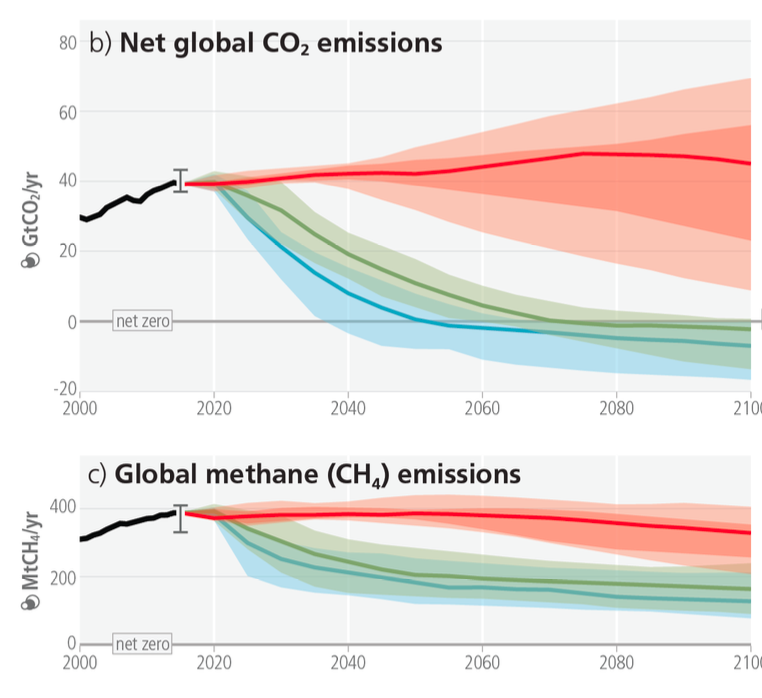
Modelling shows us that the current implemented policies to reduce global GHG emissions will likely lead to a 3.2 C increase in global temperatures (shown in red). It is evident that much stronger mitigation action will be required to meet net zero.
.png)
The Impact of Agriculture in the UK
Currently the Intergovernmental Panel on Climate Change (IPCC), who are responsible for setting the international guidelines for how all scientists calculate emissions have advised that any carbon, moving within the short carbon cycle (taken up in photosynthesis or emitted in respiration in the form of carbon dioxide) should not be included in the calculations. This means we do not include emissions from livestock breathing (or any animal for that matter) and we do not include any potential balance provided through the process of photosynthesis. The sharp increase in GHG emissions since industrialization indicates that the loss of balance within the carbon cycle occurred as we moved vast amounts of carbons that had been locked in our fossil fuels, into our atmosphere through combustion.
The latest Agri-climate report (DEFRA, 2023) identified that in 2021 UK agriculture accounted for 11% of our total GHG emissions, 49% of total UK methane (CH4) emissions (from enteric fermentation and anaerobic manure decomposition) and 1.9% of our CO2 emissions (mainly relating to fuel use). It also highlighted that methane emissions were higher in 2021 than in the previous year - see Fig 2. These figures are all calculated using a linear input/output LCA model, IPCC guidelines and assume that all GHGs should be measured in the same way, using GWP100. (Figure 2). Whilst we know this to be a gross oversimplification it highlights the ability of methane mitigation to be a credible way to reduce our overall GHG emissions, to reach net zero targets and places livestock farmers in sharp focus as a solution to decarbonise historical and on-going fossil-fuel use in industry.
Figure 2: provides a summary picture of estimated GHG emissions from agriculture since 1990
.png)
Whilst methane reduction is a clearly defined GHG reduction route identified by the UK government it is also the case that CH4 emissions from pasture fed livestock systems, when are aligned with the carrying capacity of the land they inhabit, are negligible emitters and so a reduction in methane emissions may not be needed or indeed possible for these pasture based systems. Whilst more research on the effects of pasture fed livestock is critically needed to ensure we understand the GHG picture fully, there is already evidence that pastured livestock at grass act as a net sink for methane. (Gomez-Casanovas et al., 2021; Soussana et al., 2007). It is therefore of vital importance that we take into account the management system when talking about livestock emissions, and make clear differences between biogenic, natural cycles and those arising from the burning of fossil fuels.
The Natural Carbon Cycle – biogenic greenhouse gases
A fully balanced carbon cycle would be a naturally net zero system. However, when balance is lost, such as through a reduction in trees and permanent grasslands and/or when carbon sources stored deep underground are extracted and burnt, the volume of emissions increases beyond plants’ absorption capacity and the climate warming potential increases i.e. the metaphoric greenhouse gets hotter. Globally we are emitting far more CO2 and CH4 gas into the atmosphere than plants can take back in. This excess comes predominantly from industry and the combustion of hydrocarbons such as oil and natural gas, as well as agricultural systems where livestock are stocked significantly above the carrying capacity of the land used to feed them, and rely on industrial processes to make up the shortfall.
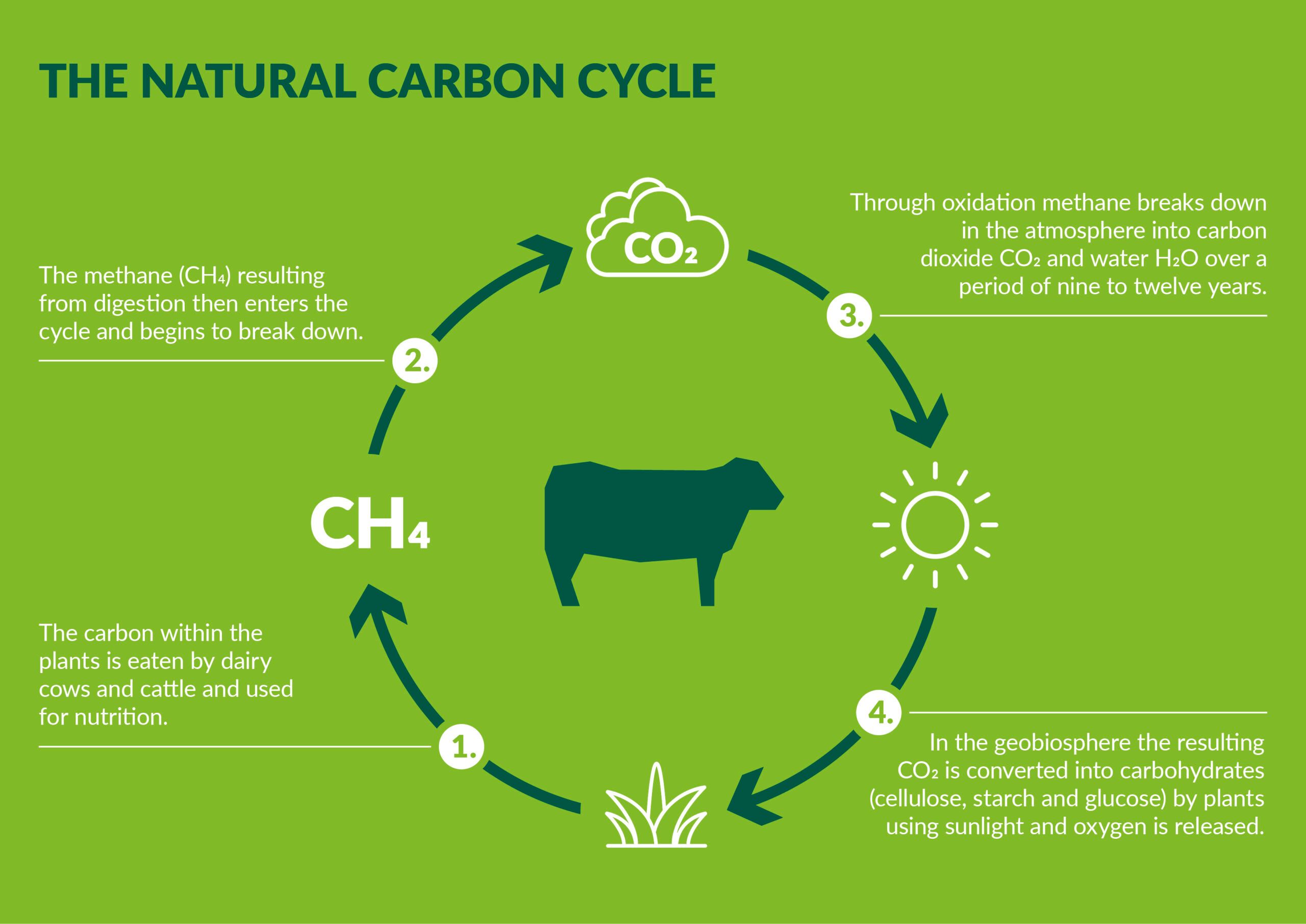
Methane (CH4) has a much shorter atmospheric lifespan of 10-12 years than carbon dioxide (often cited as persisting in the atmosphere for hundreds of years) and is naturally produced by all ruminant animals during the process of fermentation in their rumen, directly from their manure, and is naturally emitted from habitats such as wetlands. Once in the atmosphere it is broken down by oxidation back into CO2 and so we are able to track the cycling of carbon, including from methane, through our natural systems - See Fig 3. It is methane’s short atmospheric lifespan that makes it a very low hanging fruit for climate mitigation policy, as reductions in methane, currently emitted from unbalanced agricultural systems, would have a higher proportional positive impact on the GHG burden in a shorter time frame, and so agriculture is able to offer fossil fuel led industries the time they need to decarbonise.
Cycling vs Sequestration: they are not the same thing
The critical piece to understanding the natural carbon story is that it is a closed system i.e there is no new carbon being created, it is only ever in cycle, and it can be held in different reservoirs e.g., the atmosphere, vegetation, and the ground. It is our ability to lock the carbon into the ground, immobilising it within the natural carbon cycle that is often referred to as sequestration.
Fig 3: The Natural Carbon Cycle in Livestock Systems.
Carbon dioxide in the atmosphere is absorbed by plants during the process of photosynthesis and the carbon becomes incorporated into carbohydrates that are used within the structure of the plant and as a food source, with up to 30% going into the soil to “trade with other organisms and delivering ecosystem/soil health function.(Taub, 2010) The carbon source locked in plants is then consumed by ruminants who in the process of digestion create the carbon based GHG gas methane, which is released back into the atmosphere. This methane is then oxidised in the atmosphere, breaking back down into carbon dioxide and so becoming available again for absorption by plants i.e., a ‘closed loop’ cycle in a pastured system.

The problem we face is that the carbon has essentially moved from our locked-in ground reservoir to the atmosphere. This move from a stable hydrocarbon, to the GHG, carbon dioxide, has been at such a speed, and in such volumes that the plants were not able to draw enough carbon dioxide back at the same rate as it entered the atmosphere to stabilise the system. The lifespan of carbon dioxide (hundreds of years) inevitably therefore means that we not only need to reduce our level of emissions to prevent further increases in GHGs, and net zero cycling of carbon but we also need efficient ways to draw the carbon back out of the atmosphere and return as much of it into the ground as we can , as fast as we can i.e., by sequestration.
Sequestration means to “withdraw into seclusion.” This is fundamentally different to cycling. We want to withdraw the carbon from the atmosphere (prevent it cycling) and “seclude” it in our ground in both the soil and vegetation, returning it to the locked reservoir we have pillaged. It is the capacity to permanently hold carbon that holds exciting potential. It has led to a huge amount of research to understand how much carbon hedgerows and woodland can hold as well as a better understanding of soil’s capacity to lock carbon away. We now know that reduced tillage, permanent ground cover, tree planting and wetland restoration are all key to this journey. Whilst the ability to calculate the level of sequestration is not currently included in IPCC they already recognize that soil is the world’s biggest terrestrial carbon store and the “4 per 1000” initiative, launched by France at COP21 (Soussana et al., 2019), has suggested that 75% of soils are already degraded. (FAO UN, 2020). This of course leads not only to negative impacts on food security but reduces photosynthesis and the ability for organic matter to decompose and be stored in the soil.
Measuring and tracking carbon in your soil
To track a farm's success at sequestering carbon we need to know how much carbon is in the soil at a starting point, to enable us to track increases over time. The “4 per 1000” French initiative estimates that soils have the ability to increase their carbon storage by 0.04% every year in the top 30-40cms (Soussana et al., 2019).Carbon in soil can be analysed in a number of ways and farms are advised to track their carbon stores every 3-5 years, using the same methodology and laboratories each time to ensure comparable results. If you have not yet taken any measurements, we would advise you use a laboratory that is using DUMAS techniques to calculate your SOM (soil organic matter) as it offers a more stable methodology between labs and so allows accurate comparison between different farms and provides validity over time if you need to change laboratories.
Emission Modeling: Limitations, challenges, and hope
"All models are wrong, but some are useful" – George E. P. Box, British Statistician
In agricultural science, emissions from livestock systems are estimated using a modelling system called life cycle assessment (LCA). It aims to assess the environmental impact of GHGs (methane, nitrous oxide, and carbon dioxide) and resources within a farm in the process of food production. The outcome is varied but we are most familiar with it being used to calculate the CO2 equivalents per kg of food or litre of milk. The modelling takes the emissions from a system and defines it against the most widely recognized function of the commodity to society, in this case, we have to date decided this to be weight or volume.
Life Cycle Assessments are linear models and are unable to assess holistically the impact of a naturally cyclical system, making them undeniably and unfortunately still relatively crude. They usually make many assumptions, about the food that the animal is eating, the way farmers manage their manure and the production system of the farm. In addition they do not currently recognize any capacity for farms to act as a carbon sink or to sequester through the process of photosynthesis.
LCA modelling is the parent to farm carbon audits (often a compulsory obligation for farms) and whilst some of those available on the market do try to include an indication of on-farm sequestration (unlike most scientific literature) they too are limited in their accuracy as they await the research gaps to be filled with the knowledge to ensure that UK farms are fairly and consistently assessed. For example, soil carbon stocks being included alongside trees and hedgerows.
This understandably leads to farmers feeling let down and society being given emission figures that are only a partial, estimated picture, often only highlighting the pollution and not the potential for farms to act as carbon sinks, as well as an essential part of the faster carbon cycles. However the good news is that research is now happening and the assumptions currently being made are slowly but surely becoming evidenced based, with increasing accuracy. The IPCC has strict guidelines that must be followed, when calculating emissions but they already have three tiers of accuracy. Whilst Tier 1 is a very simple approach based on annual average temperature and geography it is rarely used in the UK where the more complex Tier 2 approach of bottom-up data collection is adhered to. Tier 3 is where the real detail and improvement can be made, considering farm specific measured data and changes in policy for measuring carbon sequestration. It is where UK specific methodology can be applied and mandated in policy allowing farms to gain a more accurate understanding of their emissions and provide society a more accurate understanding of the environmental impact of the food we eat.
Areas of Hope
1. GWP100 vs GWP*
A carbon dioxide equivalent (CO2-eq) is a metric measure used to compare the emissions from various GHGs on the basis of their assumed global warming potential (GWP) by converting all GHGs to the equivalent amount of carbon dioxide. The current assumed GWP metric, recommended by the IPCC, is called GWP100 where all gases' global warming potential is measured over 100 years. However, we now know that methane has a much shorter lifespan (approx. 12 years) and so a new metric GWP* has been developed to take account of the atmospheric lifespans of different greenhouse gases. The IPCC have recently published the Sixth Assessment Report (AR6) and have indicated that GWP* will likely be adopted by the IPCC and within their recommendations in the near future and this will undoubtedly down-forecast the effect of livestock methane emission estimates.
2. Nutrient density as the functional unit instead of weight
It is now widely becoming recognized that the value of food may be better considered through the nutritional quality of the food, not necessarily the weight or volume. Whilst this is an obvious statement, the functional unit most often used remains carbon dioxide equivalent per kg/l of food. Researchers are now beginning to use nutritional LCAs (nLCAS) to take account of this and there is no doubt that this will allow the model to recognise the evident benefits e.g., a kg of meat (protein) compared to a kg of sweets. This area of research will also allow comparison of the quality of nutritional content in different production methods when comparing the same protein source. McAuliffe et al., 2018, proposed a novel framework to incorporate nutritional value of meat products into livestock LCA. They showed that when using the standard mass-based approach concentrate-fed cattle produced approximately half the emissions of pasture-fed cattle. However when omega-3 content of meat was considered, these results reversed, and the concentrate-based system produced more than double the emissions of the pasture-based beef system. This difference was further exaggerated when only the most bioactive omega-three fatty acids (EPA (eicosapentaenoic acid) & DHA (docosahexaenoic acid) were included. Similar results have also been found in research looking at Welsh lamb, which found that when a mass-based functional unit was employed, grass diets had on average the highest carbon footprint, however, when omega-3 PUFA content was accounted for, the grass diet had the lowest carbon footprint (McNicol et al., 2024). This growing body of evidence is indicating that whilst mass based functional units are useful for assessing productivity efficiency they do not indicate the impact that different production system diets can have on nutritional value and so to human health.
3. Carbon Sequestration
The functional unit of livestock LCA, carbon dioxide equivalent per kg/l of food, when calculated using IPCC guidelines, does not yet include within it any measure of carbon sequestration. Furthermore, assumptions on the potential of livestock systems to offset their emissions, mostly widely cited as 0.5 ha of woodland for every 15t CO2e, are too crude, unable to take account of soil differences, the feed quality and most significantly the ability to recognise anything other than trees as a potential carbon sink. In temperate climates like the UK, where 40% of our land is identified as grassland, (UK Natural Capital Land Cover in the UK) this leaves evident gaps in our ability to fully understand agricultural impact on GHGs, when we ignore a large potential sink.
The IPCC has already identified that soil's potential to store carbon is hugely undervalued and recognised that temperate grasslands are potentially able to store a significantly greater amount of carbon per hectare, up to a metre depth, than temperate woodland - see Figure 4. Of course, the inclusion of grasslands is certainly more complicated as only permanent grassland can offer consistent estimates on the ability to sequester, with semi-permanent grasslands or grass cover in arable rotation much harder to estimate. Research looking to understand how best to produce accurate, individual, whole farm carbon measurement benchmarking, including both the carbon stored in above ground biomass, and below ground carbon stocks takes investment and technology. Whilst there are some interesting projects like ArcZero in Northern Ireland, (Gilliland, n.d.) it is still very far from being consistently included in farm carbon audits.
Figure 4.
Underestimated soils: average amount of carbon stored in vegetation and soils (up to 1 m depth) in different ecosystems-in metric tons per hectare.
.png)
4. Harmonised Carbon Audits
In June 2024, three of the most widely used carbon audit calculators, Farm Carbon Toolkit, Cool Farm Alliance and Agrecalc, announced they have signed a Memorandum of Understanding (MOU) to harmonise methodologies that they use to calculate GHG emissions in agriculture. This is a huge step forward that will allow individual farms and DEFRA to gain confidence when comparing emissions, irrelevant of the company that provides the carbon audit. This has been guided by the Defra Report “Harmonisation of Carbon Accounting Tools for Agriculture – SCF0129 (Evidence Project Final Report, n.d.).
5. Holistic Assessments: Public Good Tools and Life Cycle Sustainability Assessments.
A PGT (Public Goods Tool) is an holistic and qualitative approach achieved through interviewing the farmer and using existing farm data to highlight the performance of a farm against multiple criteria in social, economic and environmental sustainability. It is considered to be a Broad but Shallow assessment in contrast to LCAs that are narrow but in depth. (Westaway et al., 2024). Westaway et al, 2024 considered how the two approaches could be blended together into Life Cycle Sustainability Assessments, to allow the creation of a framework and metrics that consider the full breadth of sustainability and prevent hidden impact, both positive and negative from being measured on farms. You can read more about holistic assessment here.
Pasture for Life Farming Systems
We know that the interactions between soils, vegetation and grazing animals are currently not captured within LCAs. However, soil has now been recognised by the IPCC as one of the potentially biggest sinks for atmospheric carbon dioxide (see Figure 4) and so with the correct carrying capacity and grazing management, pasture-based livestock systems not only lead to biodiversity rich grasslands and higher productivity but are able to store carbon, through their root systems , leading to net zero emissions from the farm, or potentially even acting as sinks.
In addition PfL farms:
- Use appropriate livestock carrying capacities, where the farmland is able to provide forage self-sufficiency, avoiding the need to buy in feed
- Are naturally more resilient, with lower inputs of fuel, bought in forage and fertiliser (the 3 Fs), with the associated reductions in associated emissions
- Provide permanent grasslands and biodiverse habitats to maximise carbon sequestration
- Often have multi species swards (MSS) and browsing available to livestock that we know contains species that can actively reduce methane emissions e.g. sainfoin, willow, plantain and bird's foot trefoil. (Badgery et al., 2023; Meo-Filho et al., 2023; Roques et al., 2023)
What we sadly don’t have is enough research focused on ruminants naturally grazing, their direct methane emissions, the ability for grasslands to sequester or the interactions they may play in the short carbon cycle. The need to gain more data to drive our understanding of pasture based systems is a key focus for the PfL research team and as an organisation we currently collaborate in EU funded projects Pathways and Re-Livestock as well as the Land Use for Net Zero (LUNZ) projects, specifically exploring resilient grasslands. We have also worked with Dr Lisa Norton at UKCEH for a number of years, predominantly on the SEEGSLIP project, where we have been able to build the evidence that Pasture for Life member farms are more biodiverse than those under more conventional management, and have greater soil carbon stocks. In addition we have partnered with Newcastle University on the SusCatt project and have a project running currently with Rothamsted Research.
Final thoughts
Whilst many Pasture for Life farms will feel confident that they are working towards a resilient, farming system that actively supports the health of the water cycle, mineral cycle and carbon cycle, we are all of course part of a much wider global society where expectations are placed on land managers to deliver multiple outcomes, as well as food, for the benefit of society - one of which is the storage of carbon.
Carbon emissions are of course only one element of a complex narrative. We have not spoken about the impact of nitrous oxide within this article or the many other factors of sustainability beyond emissions e.g. the need to redefine efficiency beyond productivity (read more here), biodiversity, rural economy, economics, food security, food waste. We now know that a myopic view leads to unintended trade-offs but it is also important to consider the inevitable trade-offs we may need to actively accept. Achieving net zero targets will undoubtedly lead to consequences (good and bad) for society, food security and the economy, and so our role as pasture fed farmers is to showcase that well managed grazing animals at grass power the regeneration of landscapes, economies, food cultures and communities and play a vital role in rural Britain.
Reduce carbon emissions and increase carbon sequestration - start sinking not polluting.
Nikki Yoxall – Head of Research, Pasture for Life
References
https://www.gov.uk/government/statistics/agri-climate-report-2023/agri-climate-report-2023
Badgery, W., Li, G., Simmons, A., Wood, J., Smith, R., Peck, D., Ingram, L., Durmic, Z., Cowie, A., Humphries, A., Hutton, P., Winslow, E., Vercoe, P., & Eckard, R. (2023). Reducing enteric methane of ruminants in Australian grazing systems – a review of the role for temperate legumes and herbs. In Crop and Pasture Science. CSIRO. https://doi.org/10.1071/CP22299
Evidence Project Final Report. (n.d.).
FAO UN. (2020). A protocol for measurement, monitoring, reporting and verification of soil organic carbon in agricultural landscapes. In A protocol for measurement, monitoring, reporting and verification of soil organic carbon in agricultural landscapes. FAO. https://doi.org/10.4060/cb0509en
Gilliland, J. (n.d.). Achieving Net Zero-The Role of Increasing Carbon Stocks on Farm.
Gomez-Casanovas, N., Blanc-Betes, E., Moore, C. E., Bernacchi, C. J., Kantola, I., & DeLucia, E. H. (2021). A review of transformative strategies for climate mitigation by grasslands. In Science of the Total Environment (Vol. 799). Elsevier B.V. https://doi.org/10.1016/j.scitotenv.2021.149466
IPCC, 2023: Summary for Policymakers. In: Climate Change 2023: Synthesis Report. Contribution of Working Groups I, II and III to the Sixth Assessment Report of the Intergovernmental Panel on Climate Change [Core Writing Team, H. Lee, and J. Romero (eds.)]. IPCC, Geneva, Switzerland, pp. 1-34, Doi: 10.59327/IPCC/AR6-9789291691647.001
McNicol, L. C., Perkins, L. S., Gibbons, J., Scollan, N. D., Nugent, A. P., Thomas, E. M., Swancott, E. L., McRoberts, C., White, A., Chambers, S., Farmer, L., & Williams, A. P. (2024). The nutritional value of meat should be considered when comparing the carbon footprint of lambs produced on different finishing diets. Frontiers in Sustainable Food Systems, 8. https://doi.org/10.3389/fsufs.2024.1321288
Meo-Filho, P., Hood, J., Lee, M. R. F., Fleming, H., Meethal, M. E., & Misselbrook, T. (2023). Performance and enteric methane emissions from housed beef cattle fed silage produced on pastures with different forage profiles. Animal, 100726. https://doi.org/10.1016/j.animal.2023.100726
Roques, S., Koning, L., van Riel, J., Bossers, A., Schokker, D., Kar, S. K., & Sebek, L. (2023). Influence of agroecology practices on rumen microbiota associated with methane emission in dairy cattle. Animal Feed Science and Technology, 303, 115716. https://doi.org/10.1016/j.anifeedsci.2023.115716
Soussana, J. F., Allard, V., Pilegaard, K., Ambus, P., Amman, C., Campbell, C., Ceschia, E., Clifton-Brown, J., Czobel, S., Domingues, R., Flechard, C., Fuhrer, J., Hensen, A., Horvath, L., Jones, M., Kasper, G., Martin, C., Nagy, Z., Neftel, A., … Valentini, R. (2007). Full accounting of the greenhouse gas (CO2, N2O, CH4) budget of nine European grassland sites. Agriculture, Ecosystems and Environment, 121(1–2), 121–134. https://doi.org/10.1016/j.agee.2006.12.022
Soussana, J. F., Lutfalla, S., Ehrhardt, F., Rosenstock, T., Lamanna, C., Havlík, P., Richards, M., Wollenberg, E. (Lini), Chotte, J. L., Torquebiau, E., Ciais, P., Smith, P., & Lal, R. (2019). Matching policy and science: Rationale for the ‘4 per 1000 - soils for food security and climate’ initiative. Soil and Tillage Research, 188, 3–15. https://doi.org/10.1016/j.still.2017.12.002
Taub, D. (2010) Effects of Rising Atmospheric Concentrations of Carbon Dioxide on Plants. Nature Education Knowledge 3(10):21
UK Natural Capital Land Cover in the UK. (n.d.).
Westaway, S., Żyłowski, T., Hardiman, S., & Smith, L. G. (2024). Integrating sustainability assessment tools with life cycle analysis for agroecological systems: A UK case study. Agricultural Systems, 219. https://doi.org/10.1016/j.agsy.2024.104045