


shifting baseline syndrome
Has society forgetten the extraordinary diversity and ecological value that once characterised Britain’s grasslands?
Charlotte Wheeler - South West Regional Manager
shifting baseline syndrome
The term “shifting baseline syndrome” refers to what Daniel Pauly described as “‘environmental
generational amnesia”; that is, the tendency for each generation to consider the conditions they
are familiar with as the norm, even if there have been significant changes between generations.
For many people, a visible example is no longer having to stop and clean insect splatter from
the car windscreen, or the disappearance of the curlews that once called around your village.
But arguably one of the most pervasive and least visible examples is the quiet loss of diversity
in British grasslands.
Anyone travelling by train or car through the British countryside will pass by hundreds orthousands of acres of grassland.
Much of this will be classed as semi-improved or improved: agricultural terms for land that has been ploughed, fertilised or reseeded, often with a narrow range of productive species such as Italian ryegrass or white clover, to maximise yields. When thinking of grassland, this is what many of us will picture, and it’s hardly surprising; roughly 30% of the UK is covered by improved grassland. But the fact that this may be the default image for many conceals an important truth: such landscapes are a relatively recent invention. They are not the grasslands that shaped Britain’s ecology, culture or rural economies for centuries.
Unimproved grasslands (those that have never been ploughed, fertilised or reseeded) now make up around 13% of UK grasslands.
Truly species-rich unimproved grasslands account forjust 1%. That distinction matters. Improved grasslands can contain as few as two plant species, while unimproved systems such as traditional hay meadows or chalk grasslands may support 15 to 40 species per square metre. In parts of Europe where species-rich grasslands remain widespread, such as Estonia or Romania, plant diversity can exceed 50 species per square metre - levels comparable with tropical rainforests, making these grasslands among the most biodiverse habitats on Earth.
That diversity does not stop at plants.
A rich botanical mix supports a far wider range of insects, above and below ground, by providing varied food sources across the seasons. Crucially, these systems are not exposed to the pesticides found in common livestock wormers (another point in favour of organic farming practices.) In turn, insects underpin more complex food webs, supporting birds, bats, small mammals and the predators that depend on them. Around 38% of the UK’s Biodiversity Action Plan priority species rely on species-rich grasslands at some stage in their life cycle. These habitats also provide vital connectivity across the landscape, allowing species to move, forage and breed between fragmented areas.
Biodiversity is not just valuable for its own sake. It is closely linked to the delivery of ecosystem
services we rely upon.
While improved grasslands can be more productive in terms of food output, species-rich grasslands are multifunctional landscapes par excellence, providing a broader suite of benefits such as carbon storage, flood mitigation, drought resilience, pollination, nutrient cycling and long-term soil health.Yet grasslands face multiple threats. These include agricultural ‘improvement’ such as fertilisation, development, and improper recognition and protection. Indeed, as the charity Plantlife notes, while other valuable habitats such as ancient woodland feature on the government’s Irreplaceable Habitat list, species-rich meadows are afforded no comparable protection. Despite their benefits, they are also consistently underresearched and underrepresented in policy.
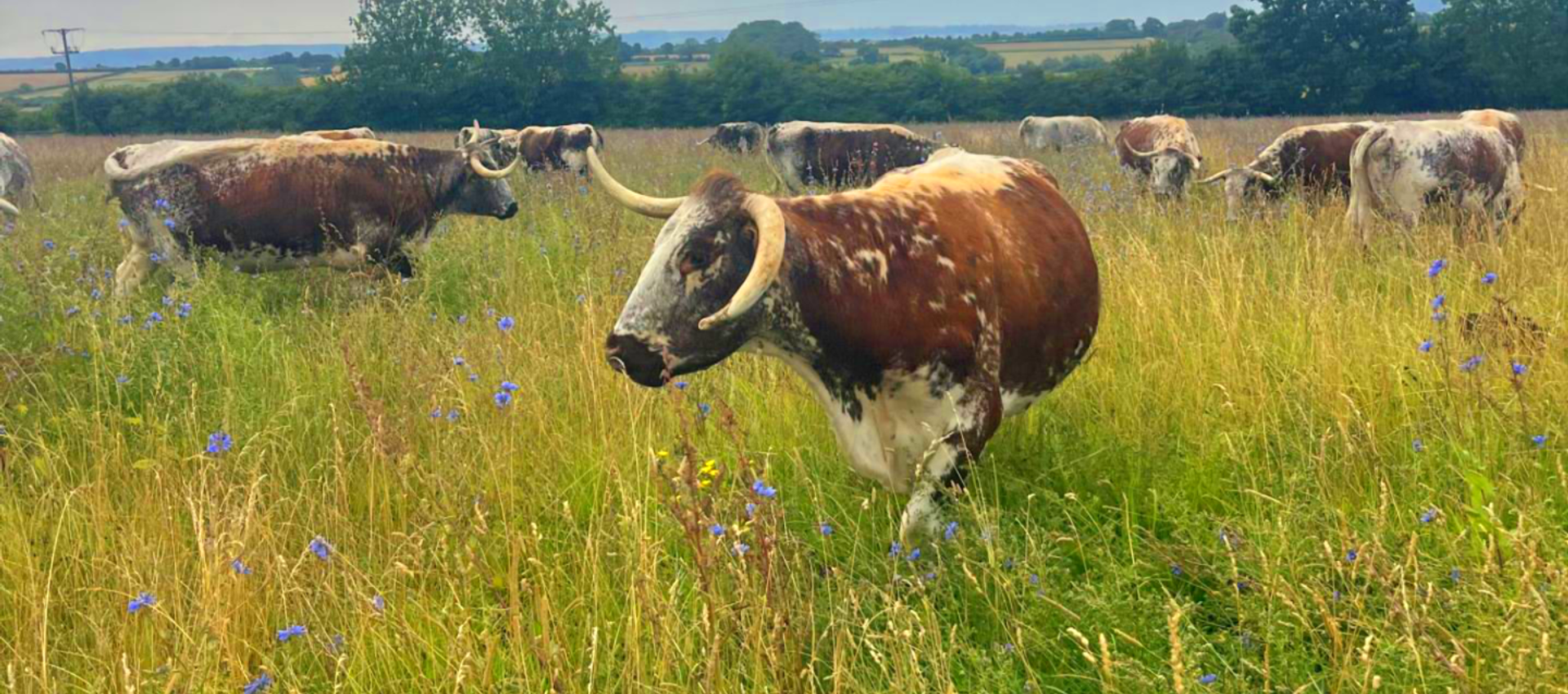
Improper management as a result of undergrazing is another threat. Animals such as cattle,
sheep, goats and horses play a crucial role in maintaining the diversity of grasslands. Without them, woody scrub encroaches, light is lost, leaf litter accumulates and delicate pasture plants are gradually out-competed. Numerous studies show that removing grazing reduces grassland diversity, eventually driving succession towards scrub and woodland. While improperly managed livestock have negative impacts on grasslands, when well-managed they are not a problem to be solved, but a key part of these landscapes’ survival.
Shifting baseline syndrome doesn’t just apply within grasslands, but includes what has been lost
between them.
“Species-rich grassland” is an umbrella term for a wide array of distinct ecosystems. Differences in geology, rainfall, soil pH and altitude produce pastoral landscapes as varied as the British Isle’s regional accents. A knowledgeable botanist in the early 20th century could likely identify their rough location simply by the composition of the pasture species underfoot. Today, much of that regional richness has been flattened. This matters because grasslands are increasingly framed in academic, policy and conservation circles as an opportunity cost; What else might we do with this land? Should it be converted to arable crops for direct human consumption? Planted with trees for carbon sequestration or ironically, biodiversity? These are legitimate questions, and there is no doubt that land use in the UK must change.
But I worry that the readiness with which grasslands are treated as “spare” or “available” reflects a profound shifting of baselines.
If we only think of grassland as improved, species-poor pasture, then perhaps it is understandable to view it as something relatively expendable, something waiting to be put to better use. What disappears from view is the extraordinary ecological potential of grasslands themselves, and how much could be recovered through changes in management alone. In that sense, the danger is not that we fail to reimagine our landscapes, but that we do so with an impoverished idea of what they once were, and could be again.