
-1-1920x850.jpg)
DEFRA’s Farming Roadmap 2050: Jimmy Woodrow responds.
DEFRA’s Farming Roadmap 2050 is the latest in a slew of reports from the government this year looking to provide clarity around the long-term direction of the food system in England.
With Andy Burnham making it clear in his first speech since becoming the MP for Makerfield that food and farming is a ‘critical sector’ (alongside steel, energy and defence), it’s possible we’re moving into a phase where sorting out the food system is at long last a key priority for government, possibly even seen as a future vote winner.
This latest document - hotly anticipated and trailed as being on message for the agroecological sector - doesn’t disappoint.
The Good
What I always felt was missing from Henry Dimbleby’s National Food Strategy, and successive governments, was an overarching vision; the ‘three compartment model’ appeared to be a clever new way of describing sitting on the fence. The farming sector has desperately required one and to be able to move on from the post-WW2 ‘production at all costs’ consensus. The vision contained on page 18 is truly heartening and I hope the beginning of a new social contract for farming.
While you can see some elements of fence sitting throughout the document, no doubt due to the diversity of organisations who were closely involved in its production, I felt when reading it that this was clear evidence that the regenerative agriculture paradigm is now mainstream. The vision locked in some of the key tenets of agroecology (I’ll highlight what’s missing later) in a common sense approach to profitable and productive nature friendly farming that is hard to argue with.
"The vision contained on page 18 is truly heartening and I hope the beginning of a new social contract for farming."
There’s more work to do to highlight the role that biological intensity, as opposed to chemical intensity, can play in delivering a more holistic approach to productivity and we need researchers to step up to that challenge.
The focus on horticulture sector growth - where you tend to find the greatest expression of biological intensity per unit of land area - is therefore critical. A thriving local and small scale horticulture sector is one of the best things we can do to build a resilient food system.
The recent relaxation of the land area required for SFI payments from 5ha to 3ha will still rule out many market gardens doing a fantastic job of feeding their local communities. Is that a missed opportunity already? As someone who is constantly irked that organic systems are a solution hiding in plain sight, bringing the Organic Action Plan back to life is an important step, confirmed by the Secretary of State in a round-table discussion I was part of at Groundswell last week.
The Roadmap makes it clear that reducing inputs is essential if we are to meet our goals, which feels like a very important statement from the government.
Few are willing to go as far as saying the vision is for farming without chemical inputs but we have to hope that, as the biological functioning of our soil recovers, a full phase out becomes a common sense rather than ideological position.
This is the key role of regenerative farming in my view. Given the importance this Roadmap places on the private sector to drive this transition I can’t help thinking more prescription will be needed to deliver this reduction in inputs: we’re still not costing negative externalities into food and we need to to accelerate change.
To those of us who are concerned that the current approach to net zero is causing further intensification in the livestock sector, the announcement that there will be environmental permitting of intensive dairy and beef systems is very welcome. So too the upcoming ‘conversation’ around emissions with the sector but we’ve got to change how we assess emissions in order to achieve the vision set out in this document. Few seem to understand this.
We need more biology and less fossil energy in the farming sector. Our approach to emissions metrics - per kg, emissions equivalence - obscures this and has been a key rationale for the intensification of livestock systems, particularly poultry and dairy.
The Bad
The focus on poultry as one of only two key sector growth areas is a serious worry.
The Roadmap states that “The farming sector will operate as a lower-input, lower emission system to produce high quality food sustainably.” This is simply not consistent with a push on poultry, which now constitutes 50% of the meat we eat and sees continued growth, pushed by well meaning environmentalists (on carbon) and health advocates (on saturated fat).
I would argue that how we assess carbon emissions and health originated from big business and the food sectors that benefit tend to be those most susceptible to vertical integration and the extraction of profits offshore. This is a key market and regulatory failure that, according to this document, the government should be trying to sort out. Unfortunately, they’re doing the complete opposite and adding fuel to the fire.
Intensive chicken (any intensive livestock sector to be clear,) simply isn’t viable if we assess carbon emissions properly and cost in negative externalities.
We need to focus on reducing fossil emissions but instead the prevailing policy and academic focus is on biogenic emissions. For those producing food without fossil fuels, these metrics undervalue their contribution to the debate. It’s strange that a document seemingly so clear eyed on the importance of environmental functioning, from the soil up, to food security, is so blind to this.
We can’t let affordability be the altar on which we sacrifice our environmental, and thus food, security. Lack of access to good food should be another market failure that the government needs to address, rather than perpetuating a system where retail price drives food production choices.
The absent
“Farming is among the sectors most exposed to climate shocks, environmental degradation, and growing resource pressures.” This is hard hitting language and hard felt by those farmers in the front line.
Every year brings a new shock and it won’t be long before we face another Covid-level crisis. For me, the biggest threat to food security is a business as usual mindset; tinkering rather than wholesale action; the idea that someone or something will come to our rescue, preventing a more systemic approach to changing our food system.
"The perennial, the multifunctional grassland systems we have should be the bedrock of our food security. Our national security even."
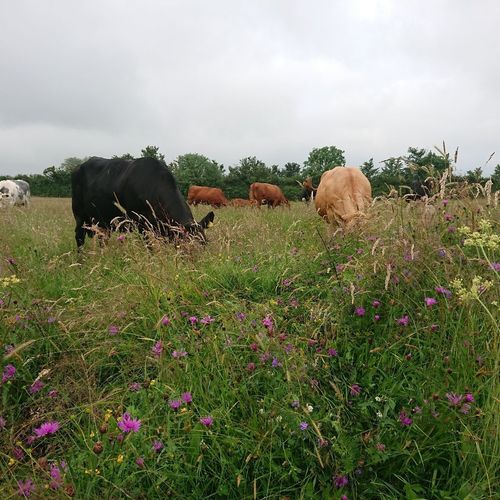
Across the UK, we are blessed to have one of the most reliable farming systems available: grasslands. With the increasing struggle to plant, nurture and harvest annual crops, the perennial, the multifunctional grassland systems we have should be the bedrock of our food security. Our national security even.
Yet grasslands barely got a mention in the Roadmap. Alluded to, perhaps, but not mentioned explicitly. Covering 40% of the UK land area and, at their best, considered to be the UK’s rainforests, these farming systems protect our biggest carbon pool in grassland soils, can soak up water and play a vital role in natural flood management, and produce the most nutrient rich food we can produce on these Isles.
Once upon a time they clothed the nation; now we wear fossil fuels. For those of us who have been arguing for their due place in societal estimation and government policy, this document shows the wait will continue, despite the fact that it is grasslands that are most resilient in the face of climate shocks and growing resource pressures. Frustratingly, the Roadmap showed more interest in methane suppressing additives than the value of regenerative grassland farming.
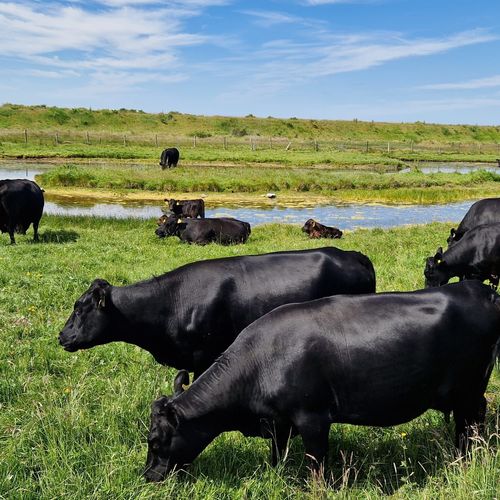
Ballyboley Dexters
Species rich grasslands are also the most reliable route we have to 30 x 30.
Productive farming systems in their own right, the journey to them for farmers needs to be supported and spelled out with stepped payments that make it clear they are not a niche, ‘premium’ habitat but could make up a vast proportion of our landscapes. Keeping them within Countryside Stewardship Higher Tier - for the few, not the many - ensures we won’t deliver on this vision. The government also needs to push for a Grassland Carbon Code so private finance can build confidence in investing in them.
If the worst comes to the worst, borders close and food production goes back to basics - a not unlikely scenario to imagine after the last five years of shocks - grass and grazing animals will overnight again become the essential cog in our food system.
Dairy cows, currently vilified by many, will be valorised for their ability to produce human nutrition on a daily basis. Ruminants in general for their ability to rapidly recycle fertility and produce something from nothing. That’s not to say these systems don’t need to change, they do, but we need to look at food security from the bottom up. What can we produce reliably? What does a UK food system look like rather than a globalised version of a UK food system? Reports that have attempted to map this out in more detail than I can do here, FFCC’s Farming for Change (2021) and Sustainable Food Trust’s Feeding Britain (2022), demonstrate this clearly.
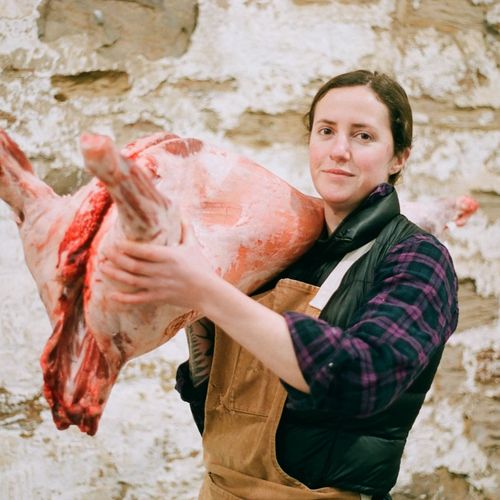
Associated with this, there was no mention of abattoirs in the Roadmap, despite the stated intention to invest in infrastructure to support the transition. Do we assume that abattoirs are included or fear for the worst?
Government efforts to date to shore up the declining small abattoir sector have failed and we need to focus on what the small abattoir of the 21st century looks like and start building them where they are needed. Europe and Japan have models we can learn from. Small abattoirs are critical national infrastructure, an integral part of delivering for nature and food security, particularly in times of crisis. There is complacency around the ability of the larger operators to serve local food systems, and Covid showed that diversity is the key driver of food system resilience. Small abattoirs are at the heart of this.
The confused
Unsurprisingly, for a government focused on economic growth, the social dimension got little coverage in the Roadmap, perhaps the greatest disconnect with a truly agroecological approach.
The best things in farming at the moment involve community building from the ground up but the word community got not one mention.
It stuck me that there was more emphasis on business and private finance coming up with solutions for the farming sector than farming communities themselves. The Farmer Collaboration Fund looks likely to be funnelled through bigger businesses, not straight to farming communities themselves. The good mention of power imbalances in the food system is moot if big business leads the way.
The one area where this trend was bucked were the passages on the Uplands. The focus on a more positive outlook for Uplands farmers is needed, possibly a government response to the historic neglect of this part of the sector and effective lobbying, though risks confusion. Singling out Upland (predominantly livestock) farmers from other livestock farmers obscures the more systemic issues we’re grappling with that I set out across this piece.
While there are unique conditions in upland areas, we need to get our approach to grazing livestock and grasslands right, and consistent across all landscapes, for the Uplands to truly flourish. Dr Hilary Cottam’s excellent analysis, now being further ground-truthed in Dartmoor and Cumbria, will not succeed if these wider systemic issues are not addressed.
For me, the biggest argument for a reduction in inputs is not environmental but the way they drain money away from farming communities.
Low input systems are more profitable and critically keep money cycling through rural economies. What’s good for rural businesses is good for rural communities.
Grazing animals are critical in this: their ability to recycle and upcycle is an incredible driver of value creation. This needs to be recognised.
%201-500x500.jpg)
To conclude, I’m convinced this Farming Roadmap is a big and important step for the sector overall.
But as we anticipate a new Prime Minister, and no doubt DEFRA Secretary, I’m also left wondering how apolitical this document is. A 25 year roadmap should have cross-party consensus but I fear that’s not the reality here.
"I’m convinced this Farming Roadmap is a big and important step for the sector overall."
I think the farming sector is more united at present than our wider political discourse and it’s more likely the Roadmap can be a vision for the sector to coalesce around than to expect it to survive a bigger political transition intact.
For those of us making the case for the importance of permanent and rotational grasslands, concerns remain and I wonder whether our collective focus would be better spent on convincing farmers to value their role more than government. If this Roadmap is the result of lengthy discussions with sector organisations then the apathy towards grasslands is broad and deep and there’s lots of work to do.
Contact Jimmy with your thoughts on the Farming Roadmap 2050.
July 2026
Related resources
- News
- Campaign
- Research
- Blog
- Chalk
- Cattle
- Sheep
- Nature
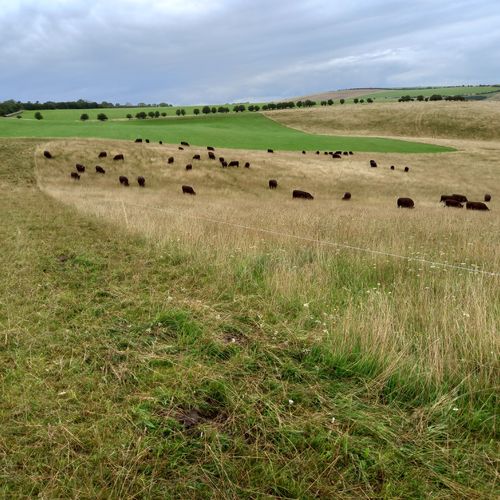
Chalk Grassland: The Rainforest of Europe
Without grazing livestock, the richness of chalk grassland would be lost because the grassland would scrub over.
13/08/25
- News
- Case study
- Blog
- Cattle
- Nature
- Dairy
- Grassland
- Sheep
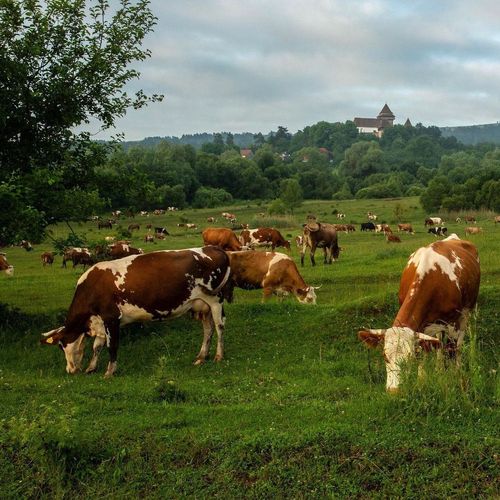
Study trip to Transylvania
Eleven Pasture for Life members visited Transylvania on a fact-finding mission for possible future Pasture for Life tours.
13/08/25