
Re-grounding the Debate: Why Critiques of Grazing often Miss the Point
Re-grounding the Debate: Why Critiques of Grazing often Miss the Point
Critics of these systems rely on models that don’t reflect reality
Last year, George Monbiot published a characteristically provocative piece in The Guardian, responding to the Sustainable Food Trust’s (SFT) report on the role of grazing animals in sustainable food systems. As ever, his column sparked a flurry of reactions. At Pasture for Life, we welcome rigorous debate about the future of food and farming. But it’s critical that such debates are grounded in context-specific, transparent, and appropriately nuanced data. Unfortunately, Monbiot’s critique, and the global modelling studies he draws on, fail to engage meaningfully with the very systems the SFT report explores.
This matters, because those systems, pasture-based, non-grain-fed, ecologically-attuned livestock farming, are not hypothetical ideals. They are real, working farms in the UK, producing nutrient-rich food while improving soil health, effectively cycling carbon, and fostering biodiversity. To dismiss these systems using data that doesn't represent them is not just inaccurate, it risks undermining the credibility of the sustainability conversation altogether.
What the SFT and FAI Reports Really Say
The SFT report is a comprehensive exploration of the potential for grazing livestock to contribute to sustainable food systems in the UK. It is an excellent report, timely and underpinned by years of work by the authors, with only one critique, that it fails to appropriately differentiate between “grass-fed” (where total diet needs to be 51% grass) and “100% pasture-fed” (where the entire diet is pasture and conserved forage).
FAI’s data showed that AMP grazing improved both ecological indicators and business performance, demonstrating a viable route for scaling regenerative approaches. Similarly, Pasture for Life-certified farms already operating without any supplementary feeding of grain or imported protein show it is possible, today, to produce high-quality dairy products, beef and lamb entirely on pasture.
What these reports demonstrate is that when ruminant livestock are managed through systems like AMP or mob grazing, the outcomes for soil carbon, water retention, biodiversity, and overall ecosystem function improve. In contrast to intensive or poorly managed grazing systems, these approaches create resilience and long-term productivity.
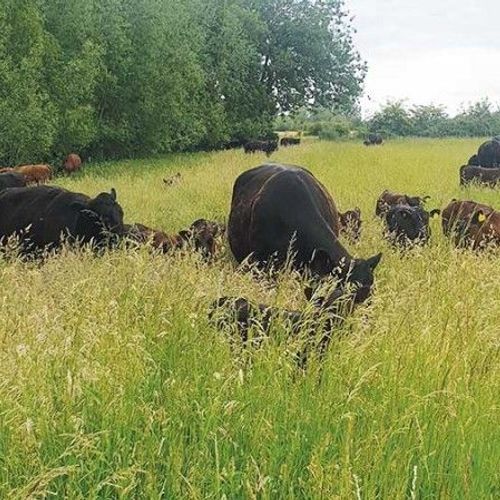
Misunderstanding Efficiency
Monbiot’s argument hinges on a familiar efficiency claim: that cattle and sheep are less efficient converters of feed than pigs or chickens, and that they invariably require grain to be economically viable. He writes:
“Given that cattle and sheep in almost all systems require supplementary feeding, and are far less efficient converters than chickens and pigs, would this proposal really ensure that less grain was needed?”
But this assumption fails on both fronts. First, Pasture for Life certification explicitly prohibits the use of grain, soy, or other concentrates. Certified farms do not rely on supplementary feed. Instead, they manage land and grazing to ensure forage availability year-round, using tools like holistic planned grazing, diverse winter forage crop mixes, and conserved grass such as hay or silage.
Second, measuring efficiency in terms of feed conversion ratios alone gives an incomplete and often misleading picture. While pigs and poultry may convert feed into meat more quickly, they are predominantly fed human-edible grains and soy, frequently imported from regions where their production is linked to environmental degradation and social harm. In contrast, ruminants in pasture-based systems, such as those certified by Pasture for Life, convert inedible forage into nutrient-dense food without competing with human food supplies.
Wilkinson (2011) makes this point clearly, arguing that livestock efficiency should not be judged by crude feed conversion figures but rather by the proportion of human-edible feed inputs used. His analysis shows that upland suckler beef and lowland lamb systems those reliant primarily on grass and forage are actually more efficient than monogastric systems when efficiency is measured by human-edible protein conversion. In other words, ruminant livestock in well-managed pasture systems use land and resources that would otherwise be unsuitable for direct human food production and produce valuable nutrition in return.
The argument Monbiot would be keen to make here is that those landscapes, where upland suckler beef herds or lowland lamb flocks are found, could be repurposed for woodlands or wetlands. This is based on an assumption that land use has to be either/or, that integration is not possible and that single use land management is the only available option. And to give George his due, the vast majority of research does unfortunately give rise to that opinion, because the modelling systems for integrated land use do not really exist. But a gap in the data doesn’t mean something isn’t true, it just means we don’t have the data. Integrated land use is a common approach on Pasture for Life farms, with wood pasture being planted to future proof livestock systems in the uplands, seasonal grazing in wetlands that maintains floristic diversity and improves bird nesting habitat and grazing of winter cereals to reduce input requirements. Just because there are limited data on these approaches doesn’t mean they are invalid or that they are uncommon. They are well known to the expert farmers that practice them, and along with many other example of creative and integrated land use systems they reflect adaptive management that actively seeks to build resilience in a changing climate and amid a biodiversity crisis.
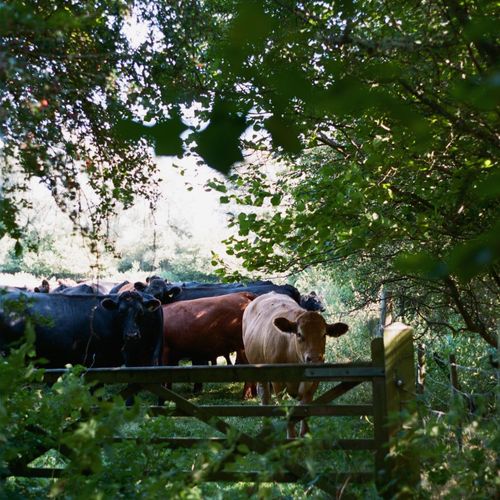
Certified Limden Brook Organic
What we do know is that Pasture for Life farms have been focusing on biodiversity as an underpinning driver of their success, not as something to sell but as a fundamental set of processes that enable better, low input farming systems to thrive. It has been found that on Pasture for Life farms grassland was generally allowed to grow tall and contained a wide range of legume and forb species and relatively low proportions of ryegrass compared to Improved Grassland, they produce a wide range of public goods including healthy landscapes, habitats, soils and livestock and tend to have very low input and fossil fuel use. Benchmarking of economic productivity revealed that Pasture for Life farmers perform better in terms of cattle production than non-Pasture for Life farmers and their willingness to optimise production and minimise inputs is done so so in shared innovative processes focused on the wellbeing of their livestock, their land, their families and themselves (SEEGSLIP).
The Problem with Poore & Nemecek
A central source for Monbiot’s argument is the 2018 paper by Poore and Nemecek, often cited as a definitive analysis of food system impacts. But while it is valuable in scope, it is also deeply limited in relevance to UK pasture-fed systems. The dataset draws heavily from global industrial production models and does not disaggregate for systems like AMP grazing or UK-specific low input systems (because we are still at an early stage of data collection for those approaches). As such, its conclusions about the environmental costs of beef and lamb are based on averages that include deforestation-linked beef from Brazil and feedlot operations from North America. Furthermore, as already explored in terms of integrated land use, this paper draws upon data sets that offer simplified understandings of land use. They assume land must be cropped or grazed, when we farmers know that spring grazing of winter sown cereals is becoming increasingly popular. They assume land can be woodland or pasture, when silvopasture (the intentional integration of livestock and trees) is not only centuries old, but is supported by research that shows it can deliver across more ecosystem services than either of its component parts.
The paper should be considered a blunt tool, unable to account for the increased carrying capacity, improved forage utilisation, and ecological benefits of rotational or mob grazing systems. The Rothamsted Research Cell Grazing Technical Report (2023) provides empirical evidence on the benefits of cell grazing systems over more conventional set stocking. The study found that cell grazing increased grassland productivity and resilience, allowing more livestock to be carried per hectare without increasing inputs, and improving soil carbon levels over time. These findings highlight the potential of well-managed grazing systems to enhance both productivity and environmental outcomes, that cell grazing increased grassland productivity and resilience, allowing more livestock to be carried per hectare without increasing inputs, and improving soil carbon levels over time.
The Poore & Nemecek paper simply doesn’t include this kind of system in its data pool. To use it to critique Pasture for Life-type farms is like criticising an electric car based on the emissions of diesel SUVs.
Livestock carrying capacity databases assume that pasture productivity is a fairly static number, that certain land types have a particular biomass output which is directly linked to the number of animals and grazing availability.
However, adaptive grazing management can completely change that.
Let’s say that by working out the grass supply of my field and the demand needs of my livestock I know I have 30 days of grazing….I put my animals into that field and 30 days later I have to take them out and find another field for them.
However, if I take that same field and split it into 30 paddocks using temporary fencing, or virtual fencing collars, by the time I reach the last paddock, the grass in the first paddock will have recovered enough for my livestock to go back in there and start the rotation again. So I get two months in that field instead of one, or possibly even 3 and depending on the weather and other environmental conditions, I may even get four rounds in that one field.
The skill and decision making it takes to deliver this sort of adaptive management is highly knowledge intensive, deeply embedded in understandings of natural processes and ecosystem function and requires adaptive capacity and community based learning to make it a success.
Evidence-Based Policy Must Reflect On-Farm Realities
The gap between modelled assumptions (one month in a field) and real-world practice (a much extended grazing season) is growing. We must be clear-eyed about the dangers of building policy, public understanding, or even dietary advice on aggregated data that fails to reflect farming systems like those being practiced across our Pasture for Life network.
A more grounded approach is offered by SEEGSLIP (Sustainable Economic and Ecological Grazing Systems - Learning from Innovative Practitioners), which assessed a wide range of regenerative livestock systems in the UK. Their findings confirm what many farmers already know: well-managed, 100% grass-fed systems can deliver across multiple fronts: productivity, ecological restoration, animal welfare, and economic resilience.
Such systems do not just "mitigate harm"; they actively contribute to the repair of landscapes and the rebuilding of rural economies. They offer a pathway forward for farmers who want to reduce their reliance on external inputs, foster biodiversity, and build business models that are resilient to climate and market shocks.
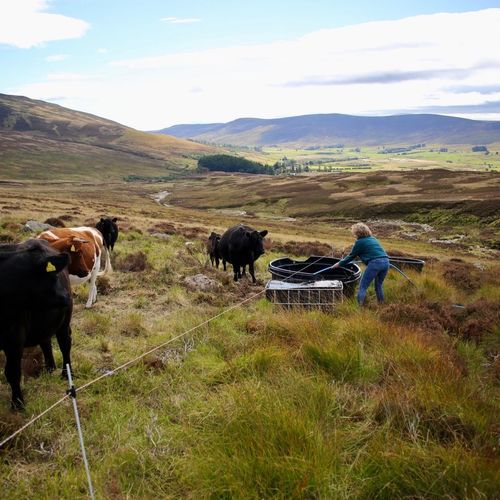
Rottal Estate by Clem Sandison
Conclusion: Let’s Talk About Which Livestock Systems
The question we face is not whether livestock are good or bad. It is which livestock systems we are talking about, and how they are managed. To conflate all forms of meat production into a single category is not only lazy, it is counterproductive.
At Pasture for Life, we stand with those who want to ask deeper, better questions. Questions like: How do we produce food that nourishes people without harming the planet? How can land be managed to store carbon, build biodiversity, and support thriving farm businesses? And how can we ensure that sustainability debates don’t erase the progress already being made by real farmers in real places?
There is no perfect system. But there are many better ones. And they are already here, hoofed, rooted in soil, and growing every day.
More resources
- Research
- Case study
- Land
- Soil
- Pasture & Profit
- Water
- Biodiversity
- Farmers
- Peer-to-peer
Pasture and Profit summary outcomes
An innovative peer-to-peer knowledge exchange model, facilitated by regional programme teams, led by experienced co-ordinators.
11/05/26

- Membership
- FAQs
 Members only
How to use the Pasture for Life forum
17/03/26
-500x500.jpg)
-500x500.png)